
Coffee Leaf Tea from El Salvador: On-Site Production Considering Influences of Processing on Chemical Composition
Abstract: The production of coffee leaf tea (Coffea arabica) in El Salvador and the influences of processing
steps on non-volatile compounds and volatile aroma-active compounds were investigated.
The tea was produced according to the process steps of conventional tea (Camellia sinensis) with
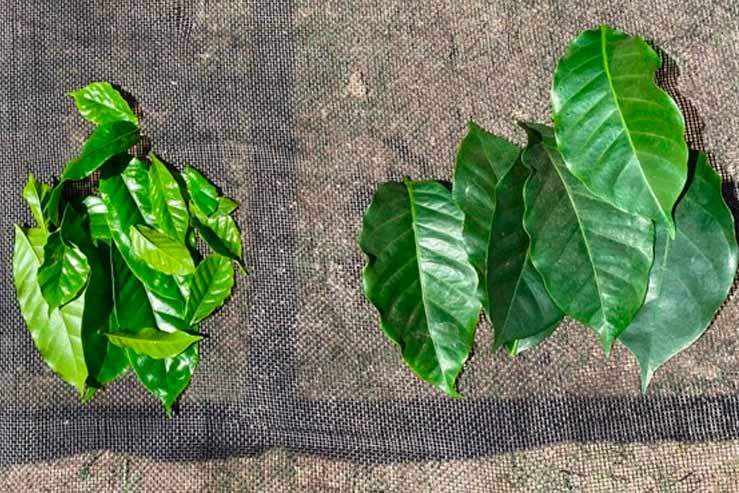
the available possibilities on the farm. Influencing factors were the leaf type (old, young, yellow,
shoots), processing (blending, cutting, rolling, freezing, steaming), drying (sun drying, oven drying,
roasting) and fermentation (wild, yeast, Lactobacillus). Subsequently, the samples were analysed
for the maximum levels of caffeine, chlorogenic acid, and epigallocatechin gallate permitted by the
European Commission. The caffeine content ranged between 0.37–1.33 g/100 g dry mass (DM),
the chlorogenic acid was between not detectable and 9.35 g/100 g DM and epigallocatechin gallate
could not be detected at all. Furthermore, water content, essential oil, ash content, total polyphenols,
total catechins, organic acids, and trigonelline were determined. Gas chromatography—mass
spectrometry—olfactometry and calculation of the odour activity values (OAVs) were carried out to
determine the main aroma-active compounds, which are b-ionone (honey-like, OAV 132-927), decanal
(citrus-like, floral, OAV 14-301), a-ionone (floral, OAV 30-100), (E,Z)-2,6-nonadienal (cucumber-like,
OAV 18-256), 2,4-nonadienal (melon-like, OAV 2-18), octanal (fruity, OAV 7-23), (E)-2 nonenal (citruslike,
OAV 1-11), hexanal (grassy, OAV 1-10), and 4-heptenal (green, OAV 1-9). The data obtained in
this study may help to adjust process parameters directly to consumer preferences and allow coffee
farmers to earn an extra income from this by-product.